Amazon Delivery Accident Lawsuit: The $56 Million Carnwath Verdict
A Middlesex Superior Court jury returned a $56 million jury verdict against Amazon in July 2026, the largest single-plaintiff, non-punitive verdict in Massachusetts history. With interest added, the total judgment Amazon owes grows to approximately $64.3 million. The case grew out of an Amazon delivery-accident lawsuit brought by Malcolm Carnwath, a man struck by an Amazon delivery van, and it has become one of the clearest public records of how Amazon structures its delivery network to distance itself from responsibility when its vans hurt people on Massachusetts roads.
Sweeney Merrigan Personal Injury Lawyers represents injured victims across Massachusetts and New Hampshire, and this verdict shows exactly what a serious Amazon delivery accident lawsuit can uncover once it reaches a courtroom.
The Case: A $56 Million Verdict Against Amazon
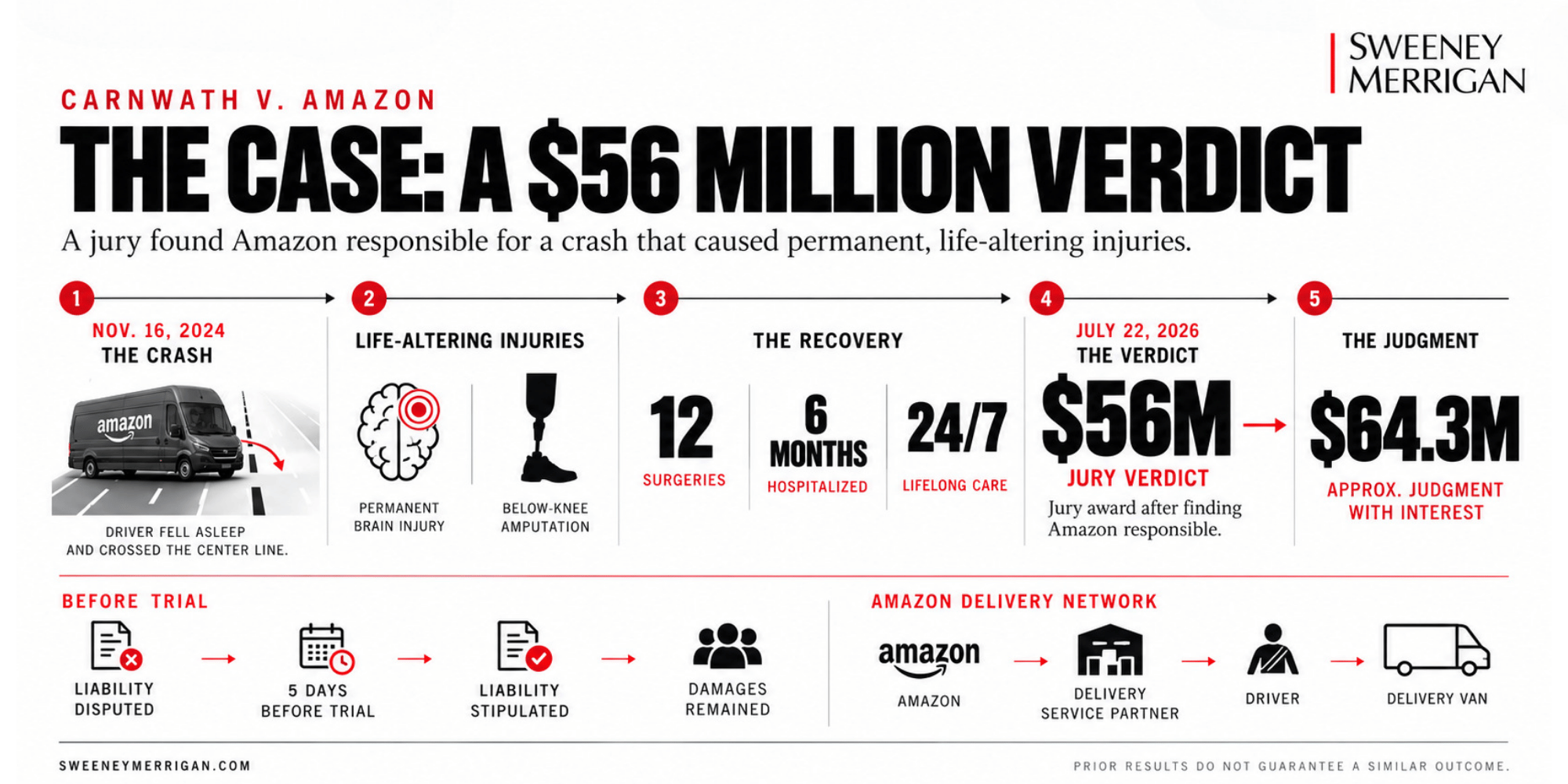
On July 22, 2026, a Middlesex Superior Court jury awarded Malcolm Carnwath, a 78-year-old retired realtor, a $56 million jury verdict after finding Amazon responsible for the crash that injured him in Portsmouth, New Hampshire, on November 16, 2024, when the delivery van driver fell asleep at the wheel and crossed the center line. With interest, the judgment against Amazon now totals approximately $64.3 million.
Carnwath suffered a permanent brain injury from a series of ischemic strokes, and his left leg was amputated below the knee. He underwent 12 surgeries, spent six months hospitalized, and will need around-the-clock care for life.
The jury verdict reflects more than the injuries alone. Amazon spent much of its discovery disputing whether it could be held liable for its Delivery Service Partner and driver. Five days before trial, it reversed course and stipulated to liability, leaving only damages for the jury to decide. Jurors still heard how Amazon structures its delivery network and reviewed the safety system in place at the time of the crash.
Who Is Liable in an Amazon Delivery Accident? The Amazon DSP Relationship Explained
Amazon can be held liable in an Amazon delivery accident lawsuit even when the driver technically works for someone else. Understanding why starts with understanding how Amazon structures its delivery network, who controls what within that network, and how courts evaluate liability when a contractor relationship sits between a company and the person who caused the harm.
What Is a Delivery Service Partner (DSP)?
A Delivery Service Partner is an independent, third-party business that contracts with Amazon to deliver its packages. Amazon does not create or own these companies. Instead, it recruits entrepreneurs through its Delivery Service Partner program, provides startup guidance, and licenses them to operate under the Amazon brand within a defined delivery area.
Once a DSP signs on, it becomes the legal employer of its drivers. The DSP hires its own workforce, runs payroll, withholds taxes, and manages the paperwork that comes with employment, benefits, scheduling, and compliance with labor law. Amazon operates thousands of these DSPs across the country, each a separate business entity responsible for its own drivers.
On paper, this structure looks straightforward: the DSP employs the driver, so the DSP bears responsibility when that driver causes a crash. In practice, the relationship is far more layered because Amazon retains significant control over how DSP drivers perform their jobs day to day.
What Amazon Controls vs. What the DSP Controls
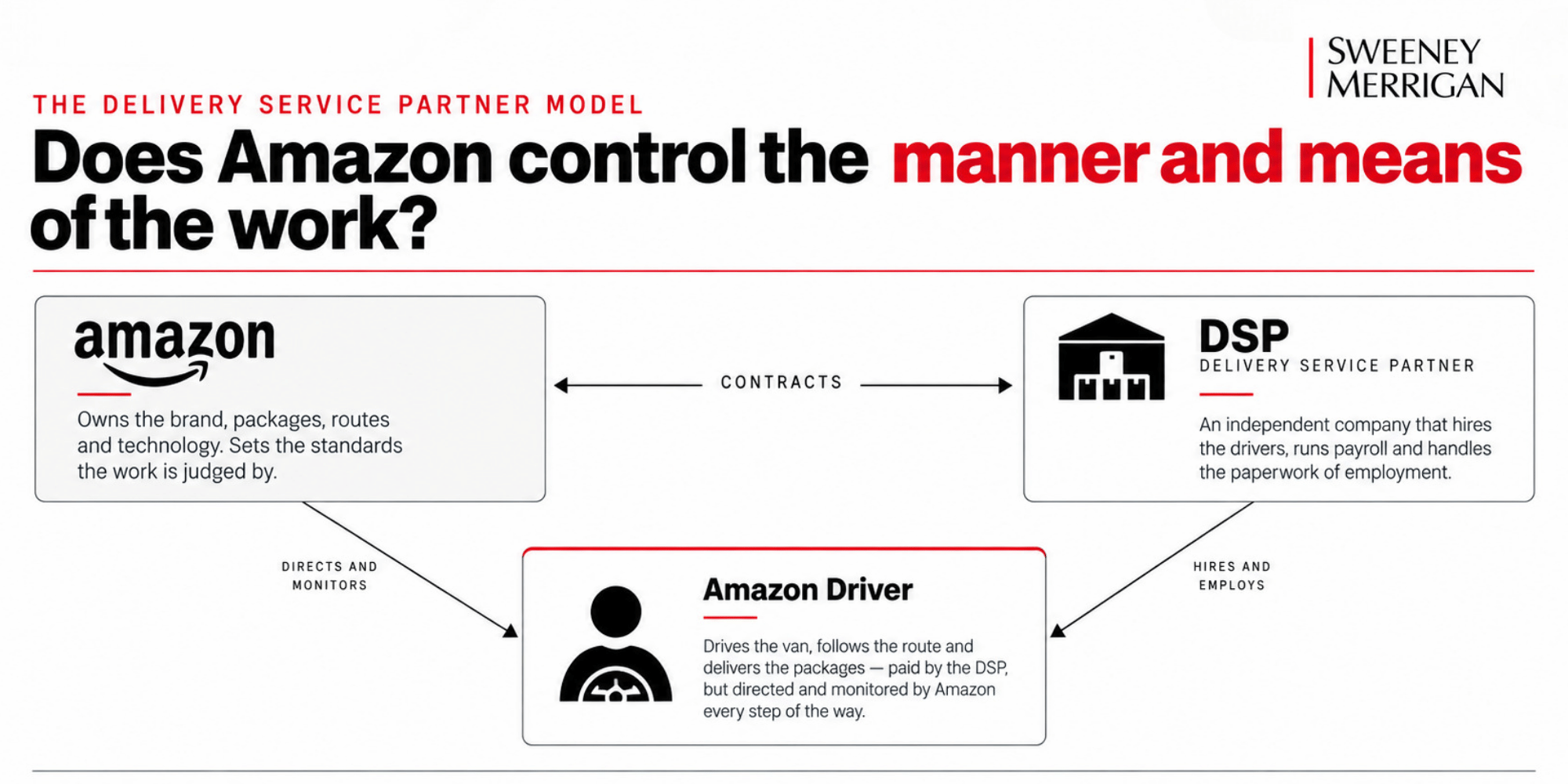
- Amazon: Controls the brand, the vans, the packages, and the software that generates delivery routes. It also sets the performance standards drivers are expected to meet.
- Delivery Service Partner (DSP): A separate, independently owned company. It hires and pays the drivers and manages their employment paperwork.
- Amazon Driver: Employed by the DSP, but follows Amazon’s routes, wears Amazon’s uniform, and drives an Amazon-branded van monitored by Amazon in real time.
Amazon controls the parts of the job that matter most to how a delivery actually happens. It owns the brand on the van and the uniform, the packages being delivered, the routes drivers follow, and the technology that generates those routes. Amazon also sets the performance standards drivers are expected to meet, including delivery speed, stop counts, and safety compliance.
The DSP, by contrast, controls the employment side of the relationship. It hires the drivers, sets their pay, runs payroll, and handles the paperwork that comes with being an employer.
The driver stands between both sides of that arrangement. Employed and paid by the DSP, the driver spends the workday following an Amazon-generated route, wearing an Amazon uniform, driving an Amazon-branded van, and operating under Amazon’s monitoring systems at every step.
The Agency Question: Can Amazon Be Held Liable for a Contractor’s Driver?
Amazon does not employ the driver. But employment is not the only thing that matters under the law. A company can be held responsible for the actions of a worker it does not directly employ when it exercises enough control over the manner and means of that work, a legal concept known as agency.
Courts do not stop at the contractor label on a piece of paper. They look at the operational reality underneath it. Who assigns the driver’s route and daily delivery quotas? Who tracks the vehicle’s speed, location, and driving behavior through onboard monitoring systems? Whose operations manual governs how the driver performs the job? These details help determine whether responsibility extends beyond the contractor named on paper.
What Happened in the Carnwath Case
The Carnwath case tested this exact question. Amazon spent much of its discovery disputing whether it could be held liable for the conduct of its Delivery Service Partner and the driver it employed, arguing that the DSP’s employment relationship with the driver ended Amazon’s responsibility for the crash.
Five days before the trial, Amazon reversed course. It stipulated liability for its Delivery Service Partner and driver, leaving only the amount of damages for the jury to decide, a rare move plaintiffs’ attorneys say could reshape how these cases are litigated nationwide. Rather than let a jury weigh Amazon’s control over routes, quotas, and monitoring systems against its contractor defense, Amazon conceded the point before trial began.
Netradyne Cameras: What Amazon’s Driver Safety System Records (and What Was Disabled)
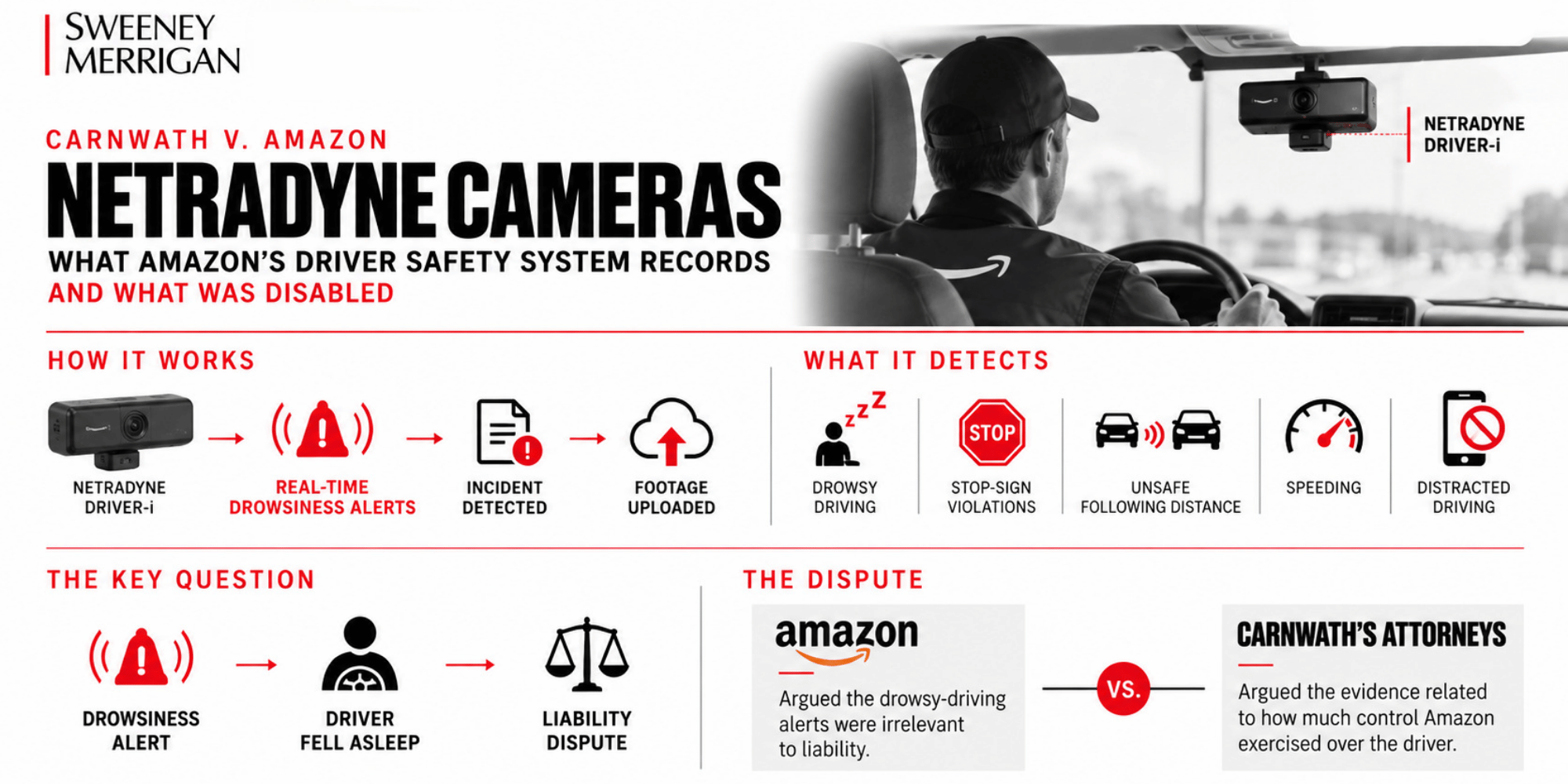
Court documents in the Carnwath case identified the safety system at the center of Amazon’s defense: the Netradyne Driver-i camera system, which Amazon uses to provide drowsy-driving alerts to its delivery drivers in real time. Amazon’s Ground Transportation Privacy Notice confirms the system also flags stop-sign violations, unsafe following distance, speeding, and distracted driving, uploading footage automatically when it detects an incident.
Court filings centered on a dispute over the drowsy-driving alerts, specifically, the very warnings that could have applied to a driver who fell asleep at the wheel. Amazon argued the alerts were irrelevant to its liability in the case; Carnwath’s attorneys argued the evidence went directly to how much control Amazon exercised over the driver.
What Makes Sweeney Merrigan Different
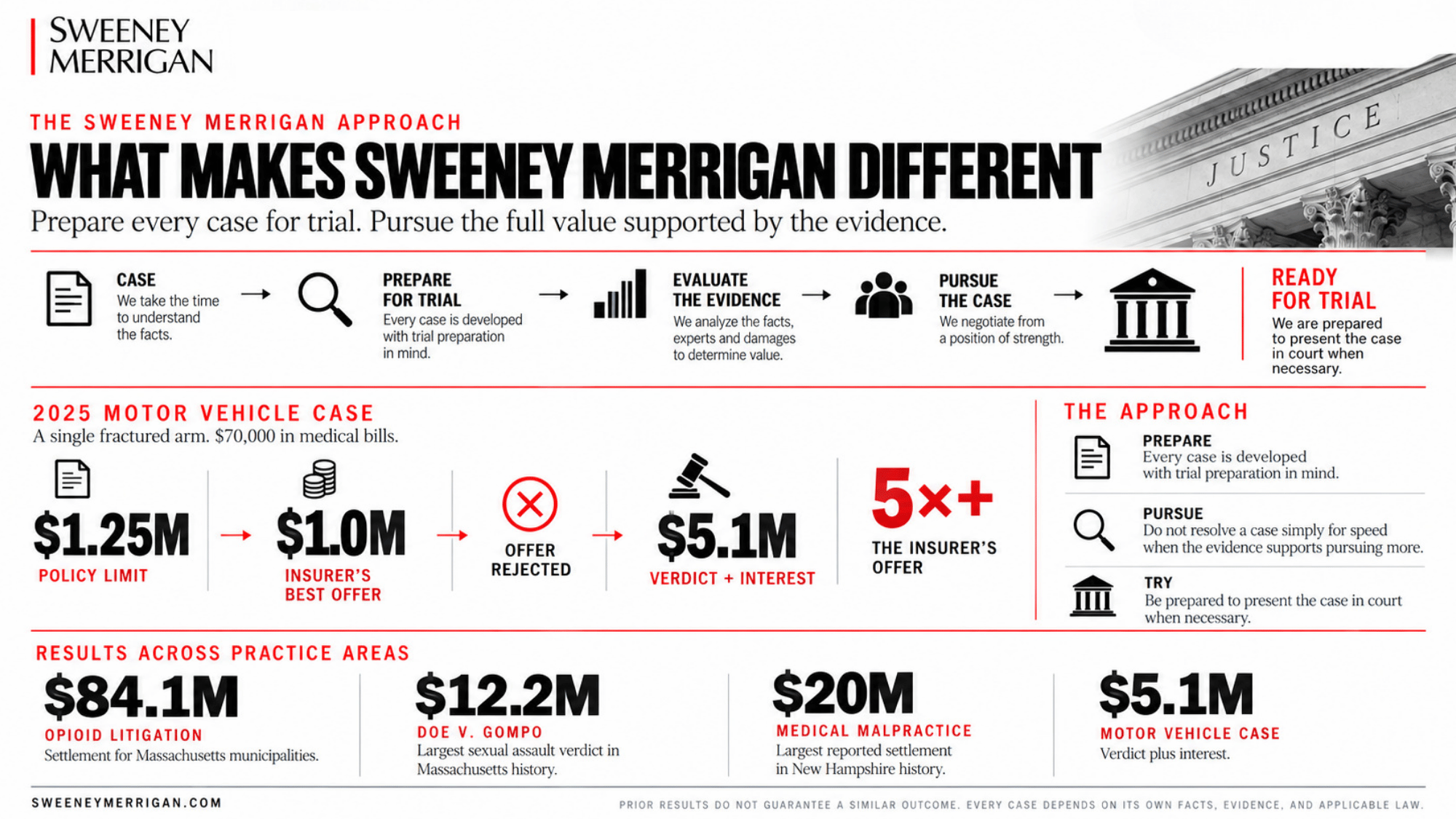
The Carnwath verdict did not happen in isolation. It reflects a pattern in how our firm approaches serious injury cases: we can prepare every case for trial, and we do not settle for less than a case is worth simply to resolve it quickly.
Our results across practice areas bear that out. We secured an $84.1 million settlement in the national opioid litigation on behalf of Massachusetts municipalities, and a $12.2 million verdict and judgment in Doe v. Gompo, the largest sexual assault verdict in Massachusetts history and the largest civil jury verdict ever returned in Franklin County. In New Hampshire, we obtained a $20 million settlement, the largest reported medical malpractice settlement in the state’s history.
One 2025 motor vehicle case shows what that approach looks like in practice. A client with a single fractured arm and $70,000 in medical bills faced an insurer with a $1.25 million policy. The insurer’s best offer was $1,000,000. Our attorneys rejected it and took the case to trial. The result: a $5.1 million verdict plus interest, more than five times what the insurer had offered to avoid a courtroom.
That willingness to try cases rather than settle them quickly is what set the Carnwath case apart from a routine claim, and it is the same approach we bring to every Amazon delivery accident lawsuit our firm handles.
These examples reflect some of our past cases. Prior results do not guarantee a similar outcome, as every case depends on its own facts, evidence, and applicable law.
Injured in an Amazon Delivery Accident? Talk to Us.
You may have grounds for an Amazon delivery accident lawsuit, regardless of who technically employed the driver at the time of the crash. If you or someone you love was hurt by an Amazon delivery van, Sweeney Merrigan Personal Injury Lawyers has fought for injured victims across Massachusetts and New Hampshire for three generations, and we know how to investigate the DSP relationship, the safety systems, and the evidence a case like this requires.
Call (617) 391-9001 today for a free consultation about your Amazon delivery accident lawsuit.